Every enterprise AI conversation in 2026 starts with the same word: agent. But the real architectural decision is not whether to build one. It is how much autonomy your use case actually needs - and most organisations are buying more than they can govern or afford.
Core Thesis
The workflow-vs-agent choice is not binary. It is a dial. Turn it too far left and you ship rigid automation that breaks on the first edge case. Turn it too far right and you ship a system you cannot price, cannot debug, and cannot defend to a regulator. Most enterprise AI projects fail not because the model was wrong. They fail because the dial was set wrong.
1. The decision nobody frames correctly
In most boardrooms, the AI conversation skips straight from "impressive demo" to "let's build an agent." The middle step - deciding how much autonomy the use case actually requires - is missed entirely.
That middle step is the first real architecture decision. It drives your token bill, your reliability, your EU AI Act exposure, and whether your team can fix the system at 2 a.m. on a Sunday. Get it right and the rest of the project becomes engineering. Get it wrong and no amount of prompt tuning will save you.
The instinct to default to "agent" is understandable. The word carries the prestige of frontier research, the marketing weight of every major AI lab, and the implicit promise that the system will figure things out so the team does not have to. But prestige is not architecture. Architecture is the deliberate placement of a dial.
2. Workflows, agents and hybrids - in plain business terms
Anthropic's working definition - from their Building Effective Agents guide (2024) - is the cleanest available: "Workflows are systems where LLMs and tools are orchestrated through predefined code paths. Agents, on the other hand, are systems where LLMs dynamically direct their own processes and tool usage."
In business language:
| System | What it is | Business analogy | When it wins |
|---|
| Workflow | A scripted sequence of steps. The LLM does a job at each station; the developer controls the route. | A recipe followed by a competent cook. | Predictable inputs, regulated outputs, high volume, thin margins. |
| Agent | A goal-driven loop. The LLM decides which tools to call and when to stop. | A chef given a kitchen and a brief. | Open-ended tasks, novel inputs, where the path cannot be known in advance. |
| Hybrid | A workflow that hands off to an agent for the one or two steps that genuinely require judgement. | An assembly line with a specialist station. | Most real enterprise use cases. |
The honest answer for nearly every European enterprise we assess is the third row. What that hybrid actually looks like in production - the five patterns that ship in 95% of European enterprise AI work - is the subject of Part 2 of this series.
3. What "agent" actually means (and what it doesn't)
Before we discuss why the dial is mis-set, it is worth stating what a real agent is - because most of what is sold as one is not.
A real agent has three properties. It pursues a goal, not a script. It chooses which tools to call and in what order. It decides when it is done. Remove any one of these and you have something else.
In practice, four things get rebranded as "agents" in enterprise procurement and they should not be.
A chatbot is not an agent. A chatbot answers a question and stops. It does not pursue a goal across multiple steps. A retrieval-augmented chatbot that fetches one document and summarises it is a workflow with one LLM call. Calling it an agent is marketing.
RPA is not an agent. Robotic process automation follows a fixed sequence of UI actions. The path is hard-coded. Adding an LLM to extract data from a form does not change that - it is a workflow with an LLM step. Useful, often the right choice, but not an agent.
Retrieval is not an agent. A system that searches a vector database and returns relevant chunks is doing retrieval. Even if the retrieval is multi-hop, if the retrieval logic is coded by a developer, it is a workflow. Agency requires the model itself to decide what to retrieve next based on what it just found.
A workflow with a long prompt is not an agent. A 4,000-token system prompt that lists thirty tools does not make a workflow autonomous. If the code dispatches the next step, the code is in charge, not the model.
Gartner's analysts call this pattern "agent washing" and estimate that only a small fraction of the thousands of agentic vendors in the market are doing something that meets the definition. The implication for procurement teams: when a vendor says "agent," ask which of the three properties - goal, tool choice, termination - their system actually owns. If the answer is none, the price tag should reflect a workflow, not an agent.
This matters because the cost, governance and reliability arguments below all change shape depending on which one you are actually buying.
4. Why the dial is usually set too far toward "agent"
Three forces push organisations rightward before the business case justifies it.
The cost reframing
Cheaper tokens do not mean cheaper AI. Production data shows agents use roughly 4× more tokens than a single LLM call, and multi-agent systems around 15× more. At enterprise volume this is a budget-line decision, not a technical footnote. A workflow that costs €0.005 per task at pilot becomes €0.005 per task in production. An agent that costs €0.05 at pilot can cost €0.20-€0.50 at production scale, because production inputs are messier and the loops run longer.
The reliability reframing
A workflow is deterministic - same input, same output, traceable when it breaks. An agent is non-deterministic - it can solve the same problem two different ways. That is powerful for research and triage. It is dangerous for claims processing, credit decisions, or anything a regulator can ask you to reproduce. Non-determinism is not a bug - it is a feature you may not want. A 2025 security survey of LLM-based agents (arXiv:2506.23844) formalises this as a risk gradient: L1–L2 systems can rely on static safeguards; L3 and above require adaptive oversight - which is precisely what EU AI Act Article 14 mandates.
The market reframing
Gartner research on agentic AI projects warns of widespread project abandonment, citing "escalating costs, unclear business value or inadequate risk controls." In the deployments we assess, the failure is rarely the model. It is autonomy granted where it was never needed.
The failure is rarely the model. It is autonomy granted where it was never needed.
5. The CLEAR Autonomy Test
The CLEAR test is our own synthesis. The five-position dial is grounded in a converging body of published frameworks: the Cornell/Knight First Amendment Institute's user-role taxonomy (Archipelago et al., arXiv:2506.12469, 2026), the ASDLC L1–L5 autonomy scale (2026), and Anthropic's Building Effective Agents (2024). The "levels" metaphor originates with SAE J3016 driving automation - a lineage shared by all the frameworks cited below.
Before you build, run the use case through five questions. The more "yes" answers, the further right on the dial you belong. Anything else defaults to a workflow or a hybrid with a human checkpoint.
C
Can the path be scripted?If a competent engineer can draw the decision tree on a whiteboard, build a workflow.
L
Latency and cost tolerance?High volume, thin margins, sub-second response - stay left.
E
Exceptions and variability?If edge cases dominate and inputs are unpredictable, autonomy starts to earn its keep.
A
Accountability and audit needs?Regulated decisions favour deterministic, auditable workflows. The EU AI Act, Article 14, requires high-risk systems to be designed so they "can be effectively overseen by natural persons," with oversight "commensurate with the level of autonomy." Interface EU's autonomy classification (2025) maps this to liability: above L3, liability shifts progressively from deployer to developer.
R
Reversibility of actions?If a mistake is expensive or hard to undo, constrain autonomy and add a human-in-the-loop.
The dial that follows from the test has five positions, not two:
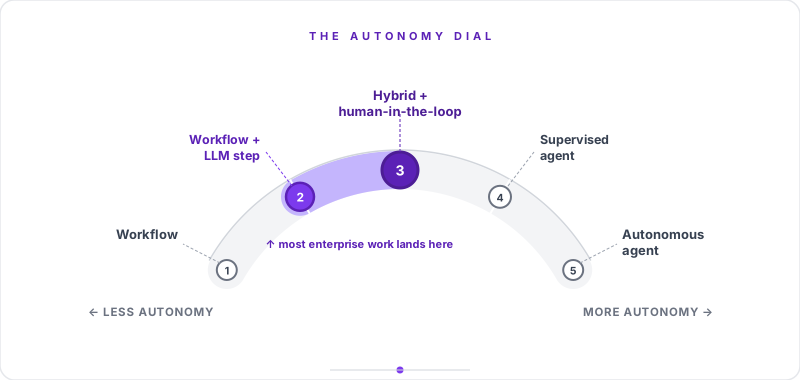
Most enterprise systems we ship sit in positions two and three - what the ASDLC scale terms L2–L3 (Conditional Autonomy) and what the Cornell/Knight Institute framework describes as the Collaborator-to-Consultant range. Position five - a fully autonomous agent acting on consequential decisions without human review - is rare in regulated European environments and, in our view, should be.
The one-sentence test: if you can write down every step in advance, build a workflow. If the path cannot be known until the task is underway, that is where an agent belongs - and even then, put a human at the checkpoint.
6. What this looks like in European enterprises
Three short examples, each showing a different point on the dial.
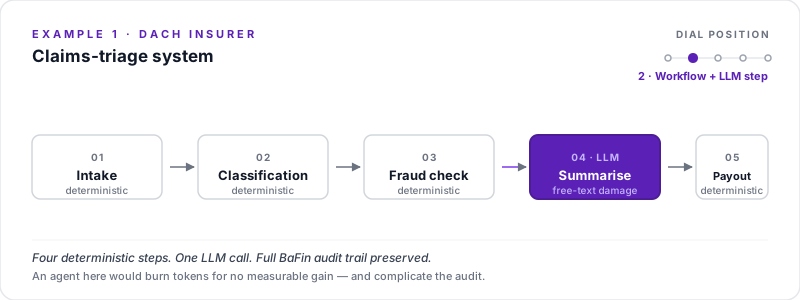
A claims-triage system for a DACH insurer
90% of the work is a workflow - intake, classification, fraud checks, payout calculation - with a single LLM call to summarise free-text damage descriptions. An agent here would burn tokens for no measurable gain and complicate the BaFin audit trail.
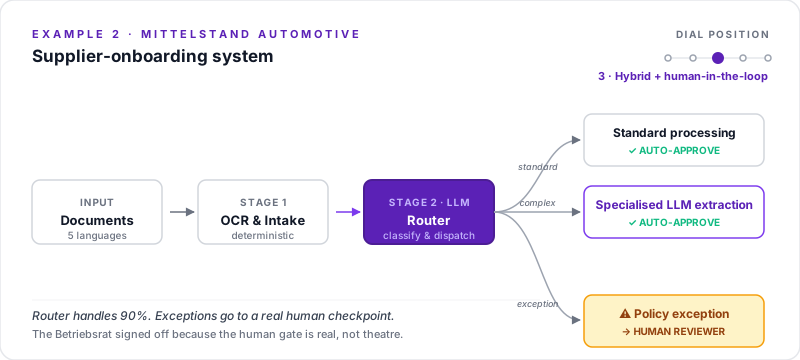
A supplier-onboarding system for a Mittelstand automotive group
Multi-format documents arrive in five languages from hundreds of suppliers. A workflow handles intake and OCR; a routing step dispatches to specialised processing; a human approves anything that fails policy checks. The Betriebsrat signed off because the human checkpoint is real, not theatre.
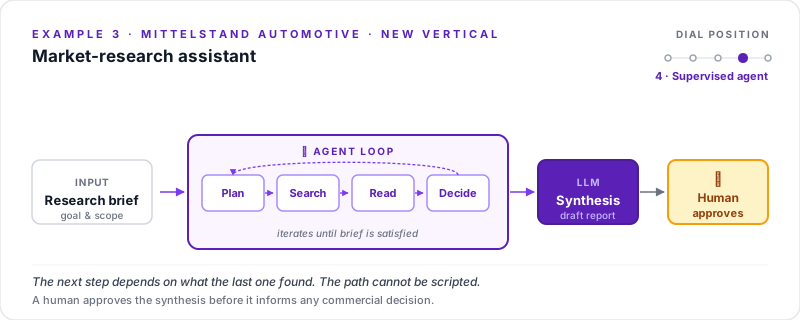
A market-research assistant for the same group entering a new vertical
The path genuinely cannot be scripted - the next search depends on what the last one found. A supervised agent, with a human approving the final synthesis before it informs any commercial decision, earns its cost.
Same company. Three use cases. Three settings on the dial. That is what deliberate placement looks like.
7. Three questions to ask your AI team this week
- For our current agent project, could 80% of it be a workflow with one or two LLM calls? What would we lose?
- What is the token cost per task today, and what does it become at 10× volume?
- If a regulator asked us to reproduce the system's decision from last Tuesday, could we?
Key takeaways
→
Workflows and agents are not rivals. They are points on an autonomy dial.
→
Most of what is sold as an "agent" is a chatbot, RPA, or a workflow with a long prompt. Ask which of goal, tool choice, and termination the system actually owns.
→
Start as far left as the use case allows. Add autonomy only when the business case demands it.
→
Cost, reliability, and EU AI Act oversight all favour the middle of the dial for most enterprise work.
→
The failure mode is not picking the wrong technology. It is not deciding deliberately.
Not sure where your use case sits on the autonomy dial? We help European enterprises place the dial deliberately.
Book a 30-min call →
Jedes KI-Gespräch in Unternehmen beginnt 2026 mit demselben Wort: Agent. Aber die eigentliche Architekturentscheidung ist nicht, ob man einen baut. Es geht darum, wie viel Autonomie der Anwendungsfall wirklich braucht – und die meisten Unternehmen kaufen mehr davon, als sie steuern oder bezahlen können.
Kernthese
Die Workflow-versus-Agent-Entscheidung ist keine Binärwahl. Sie ist ein Regler. Drehen Sie ihn zu weit nach links, bauen Sie starre Automatisierung, die beim ersten Sonderfall bricht. Drehen Sie ihn zu weit nach rechts, bauen Sie ein System, das Sie weder bepreisen noch debuggen noch einem Prüfer erklären können. Die meisten Unternehmens-KI-Projekte scheitern nicht am falschen Modell. Sie scheitern daran, dass der Regler falsch stand.
1. Die Entscheidung, die niemand richtig stellt
In den meisten Vorstandsetagen springt das KI-Gespräch direkt von „beeindruckende Demo“ zu „lasst uns einen Agenten bauen.“ Der Schritt dazwischen – zu entscheiden, wie viel Autonomie der Anwendungsfall wirklich braucht – wird übersprungen.
Das ist die erste echte Architekturentscheidung. Sie bestimmt Ihre Tokenkosten, Ihre Zuverlässigkeit, Ihr EU-AI-Act-Risiko und ob Ihr Team das System sonntags um 2 Uhr nachts noch reparieren kann. Liegt die Entscheidung richtig, wird der Rest zum Engineering. Liegt sie falsch, hilft kein Prompt-Tuning der Welt.
Der Reflex, zu „Agent“ zu greifen, ist verständlich. Das Wort trägt das Prestige der Grundlagenforschung, das Marketinggewicht jedes großen KI-Labors und das implizite Versprechen, dass das System schon herausfindet, was das Team nicht muss. Aber Prestige ist keine Architektur. Architektur ist die bewusste Einstellung eines Reglers.
2. Workflows, Agenten und Hybride – auf den Punkt gebracht
Anthropics Arbeitsdefinition – aus dem Leitfaden Building Effective Agents (2024) – ist die klarste, die es gibt: "Workflows sind Systeme, in denen LLMs und Werkzeuge über vordefinierte Code-Pfade orchestriert werden. Agenten hingegen sind Systeme, in denen LLMs ihre eigenen Prozesse und Werkzeugnutzung dynamisch steuern."
In Geschäftssprache:
| System | Was es ist | Geschäftsanalogie | Wann es gewinnt |
|---|
| Workflow | Eine vorgeschriebene Abfolge von Schritten. Das LLM erledigt an jeder Station eine Aufgabe; der Entwickler steuert die Route. | Ein Rezept in den Händen einer kompetenten Köchin. | Vorhersagbare Eingaben, regulierte Ausgaben, hohes Volumen, enge Margen. |
| Agent | Eine zielorientierte Schleife. Das LLM entscheidet, welche Werkzeuge es aufruft und wann es stoppt. | Ein Koch, dem man eine Küche und ein Briefing gibt. | Offene Aufgaben, neuartige Eingaben, Situationen, in denen der Weg vorher nicht bekannt sein kann. |
| Hybrid | Ein Workflow, der an ein oder zwei Stellen, wo echte Urteilsfähigkeit gefragt ist, an einen Agenten übergibt. | Ein Fließband mit einer Spezialistenstation. | Die meisten echten Unternehmensanwendungen. |
Die ehrliche Antwort für nahezu jedes europäische Unternehmen, das wir bewerten, ist die dritte Zeile. Wie dieser Hybrid in der Produktion konkret aussieht – die fünf Muster, die 95 % der europäischen Unternehmens-KI-Projekte abdecken – ist Thema von Teil 2 dieser Serie.
3. Was ein KI-Agent wirklich ist – und was nicht
Bevor wir erläutern, warum der Regler zu oft falsch steht, lohnt es sich klarzustellen, was ein echter Agent ist – denn das meiste, was als Agent verkauft wird, ist keiner.
Ein echter Agent hat drei Eigenschaften. Er verfolgt ein Ziel, kein Skript. Er wählt selbst, welche Werkzeuge er in welcher Reihenfolge aufruft. Er entscheidet, wann er fertig ist. Fehlt eine dieser Eigenschaften, haben Sie etwas anderes.
In der Praxis werden im Einkauf von Unternehmen vier Dinge als „Agenten“ bezeichnet, die es nicht sind.
Ein Chatbot ist kein Agent. Ein Chatbot beantwortet eine Frage und hört auf. Er verfolgt kein Ziel über mehrere Schritte. Ein RAG-Chatbot, der ein Dokument abruft und zusammenfasst, ist ein Workflow mit einem einzigen LLM-Aufruf. Ihn als Agenten zu bezeichnen, ist Marketing.
RPA ist kein Agent. Robotic Process Automation folgt einer festen Abfolge von UI-Aktionen. Der Weg ist fest programmiert. Das Hinzufügen eines LLMs zum Extrahieren von Daten aus einem Formular ändert das nicht – es ist ein Workflow mit einem LLM-Schritt. Nützlich, oft die richtige Wahl, aber kein Agent.
Retrieval ist kein Agent. Ein System, das eine Vektordatenbank durchsucht und relevante Abschnitte zurückgibt, betreibt Retrieval. Selbst wenn das Retrieval mehrere Hops umfasst: Wenn die Suchlogik vom Entwickler codiert wurde, ist es ein Workflow. Echtes Agentenverhalten setzt voraus, dass das Modell selbst entscheidet, was es als nächstes abruft – basierend auf dem, was es gerade gefunden hat.
Ein Workflow mit einem langen Prompt ist kein Agent. Ein 4.000-Token-Systemprompt, der dreißig Werkzeuge auflistet, macht einen Workflow nicht autonom. Wenn der Code den nächsten Schritt auslöst, hat der Code das Sagen – nicht das Modell.
Gartners Analysten nennen dieses Muster „Agent Washing“ und schätzen, dass nur rund 130 der Tausenden Anbieter von Agentic AI auf dem Markt etwas bieten, das der Definition tatsächlich entspricht. Das ist kein Tippfehler. Die Konsequenz für Einkaufsteams: Nennt ein Anbieter sein Produkt einen „Agenten“, fragen Sie, welche der drei Eigenschaften – Ziel, Werkzeugwahl, Terminierung – sein System wirklich besitzt. Lautet die Antwort „keine“, sollte der Preis einen Workflow widerspiegeln, nicht einen Agenten.
Das ist deshalb wichtig, weil die Argumente zu Kosten, Governance und Zuverlässigkeit weiter unten alle eine andere Form annehmen – je nachdem, was Sie tatsächlich einkaufen.
4. Warum der Regler zu oft Richtung „Agent“ steht
Drei Kräfte drängen Unternehmen nach rechts, bevor der Business Case es rechtfertigt.
Die Kostenperspektive
Günstigere Token bedeuten keine günstigere KI. Anthropics eigene Produktionsdaten zeigen, dass Agenten rund 4-mal mehr Token verbrauchen als ein einzelner LLM-Aufruf – Multi-Agenten-Systeme sogar rund 15-mal mehr. Bei Unternehmensvolumen ist das eine Budgetentscheidung, keine technische Fußnote. Ein Workflow, der im Pilotprojekt 0,005 € pro Aufgabe kostet, kostet auch in der Produktion 0,005 €. Ein Agent, der im Pilot 0,05 € kostet, kann in der Produktion 0,20-0,50 € kosten – weil Produktionseingaben unordentlicher sind und die Schleifen länger laufen.
Die Zuverlässigkeitsperspektive
Ein Workflow ist deterministisch – gleiche Eingabe, gleiche Ausgabe, nachvollziehbar wenn er bricht. Ein Agent ist nicht-deterministisch – er kann dasselbe Problem auf zwei verschiedene Arten lösen. Das ist wertvoll für Recherche und Triage. Es ist gefährlich für die Schadenbearbeitung, Kreditentscheidungen oder alles, was ein Prüfer reproduziert sehen möchte. Nicht-Determinismus ist kein Fehler – er ist ein Feature, das Sie möglicherweise nicht wollen. Eine Sicherheitsstudie aus dem Jahr 2025 (arXiv:2506.23844) formalisiert dies als Risikogradient: L1–L2-Systeme können mit statischen Sicherheitsmechanismen betrieben werden; ab L3 ist adaptive Aufsicht erforderlich – genau das, was EU-AI-Act Artikel 14 vorschreibt.
Die Marktperspektive
Gartner prognostiziert, dass über 40 % der Agentic-KI-Projekte bis Ende 2027 eingestellt werden – mit der Begründung „eskalierender Kosten, unklarer Geschäftswert oder unzureichende Risikokontrolle.“ Dieselbe Analyse liefert uns die Agent-Washing-Zahl von oben. In den Deployments, die wir bewerten, liegt der Fehler selten beim Modell. Er liegt darin, Autonomie dort gewährt zu haben, wo sie nie gebraucht wurde.
Das Scheitern liegt selten am falschen Modell. Es liegt darin, Autonomie dort zu gewähren, wo sie nie gebraucht wurde.
5. Der CLEAR-Autonomietest
Der CLEAR-Test ist unsere eigene Synthese. Die fünf Positionen des Reglers basieren auf einer Reihe publizierter Frameworks: dem Benutzerrollen-Modell des Cornell/Knight First Amendment Institute (Archipelago et al., arXiv:2506.12469, 2026), der ASDLC L1–L5-Autonomieskala (2026) und Anthropics Building Effective Agents (2024). Die „Stufen“-Metapher entstammt dem SAE J3016-Standard für Fahrautomatisierung – eine Herkunft, die alle genannten Frameworks teilen.
Bevor Sie bauen, prüfen Sie den Anwendungsfall anhand von fünf Fragen. Je mehr „Ja“-Antworten, desto weiter rechts am Regler gehören Sie. Alles andere fällt auf einen Workflow oder einen Hybrid mit menschlichem Kontrollpunkt zurück.
C
Kann der Weg skriptiert werden?Wenn ein kompetenter Ingenieur den Entscheidungsbaum auf einem Whiteboard zeichnen kann, bauen Sie einen Workflow.
L
Latenz- und Kostentoleranz?Hohes Volumen, enge Margen, Reaktionszeit unter einer Sekunde – bleiben Sie links.
E
Ausnahmen und Variabilität?Wenn Sonderfälle dominieren und Eingaben unvorhersehbar sind, beginnt Autonomie sich auszuzahlen.
A
Rechenschaftspflicht und Prüfanforderungen?Regulierte Entscheidungen begünstigen deterministische, prüfbare Workflows. Der EU-AI-Act, Artikel 14, verlangt, dass Hochrisikosysteme so gestaltet sind, dass sie „von natürlichen Personen wirksam beaufsichtigt werden können“ – die Aufsicht muss „dem Grad der Autonomie angemessen“ sein. Interface EUs Autonomie-Klassifikationsrahmen (2025) verbindet dies direkt mit Haftung: Ab L3 verlagert sich die Haftung schrittweise vom Betreiber zum Entwickler.
R
Reversibilität der Aktionen?Wenn ein Fehler teuer oder schwer rückgängig zu machen ist, begrenzen Sie die Autonomie und fügen Sie einen menschlichen Kontrollpunkt hinzu.
Der Regler, der sich aus diesem Test ergibt, hat fünf Positionen, nicht zwei:
Die meisten Systeme, die wir ausliefern, liegen auf Position zwei und drei – was die ASDLC-Skala als L2–L3 (Bedingte Autonomie) bezeichnet und was das Cornell/Knight-Institute-Framework als den Collaborator-bis-Consultant-Bereich beschreibt. Position fünf – ein vollautonomer Agent, der folgenreiche Entscheidungen ohne menschliche Prüfung trifft – ist in regulierten europäischen Umgebungen selten und sollte es unserer Ansicht nach auch bleiben.
Der Ein-Satz-Test: Wenn Sie jeden Schritt im Voraus aufschreiben können, bauen Sie einen Workflow. Wenn der Weg erst während der Aufgabe bekannt wird, gehört dort ein Agent hin – und selbst dann: Setzen Sie einen Menschen an den Kontrollpunkt.
6. So sieht das in europäischen Unternehmen aus
Drei kurze Beispiele, jedes an einem anderen Punkt am Regler.
Ein Schaden-Triage-System für einen DACH-Versicherer
90 % der Arbeit ist ein Workflow – Eingang, Klassifizierung, Betrugsprüfung, Auszahlungsberechnung – mit einem einzigen LLM-Aufruf, der Schaden-Freitexte zusammenfasst. Ein Agent würde hier Token verbrennen, ohne messbaren Mehrwert zu bringen, und die BaFin-Prüfspur verkomplizieren.
Ein Lieferanten-Onboarding-System für einen Mittelständler in der Automobilindustrie
Dokumente in fünf Sprachen treffen von hunderten Lieferanten in unterschiedlichsten Formaten ein. Ein Workflow übernimmt Eingang und OCR; ein Routing-Schritt leitet an spezialisierte Verarbeitung weiter; ein Mensch genehmigt alles, was die Richtlinienprüfung nicht besteht. Der Betriebsrat hat zugestimmt, weil der menschliche Kontrollpunkt real ist – kein Feigenblatt.
Ein Marktforschungsassistent für denselben Konzern beim Einstieg in ein neues Segment
Der Weg ist wirklich nicht vorhersagbar – die nächste Suchanfrage hängt davon ab, was die letzte ergeben hat. Ein beaufsichtigter Agent, bei dem ein Mensch die finale Synthese genehmigt bevor sie eine Geschäftsentscheidung beeinflusst, rechtfertigt seine Kosten.
Dasselbe Unternehmen. Drei Anwendungsfälle. Drei Reglerpositionen. Genau so sieht bewusste Positionierung aus.
7. Drei Fragen für Ihr KI-Team diese Woche
- Könnte 80 % unseres aktuellen Agenten-Projekts ein Workflow mit ein oder zwei LLM-Aufrufen sein? Was würden wir verlieren?
- Was sind die Token-Kosten pro Aufgabe heute, und wie entwickeln sie sich bei 10-fachem Volumen?
- Wenn ein Prüfer uns bitten würde, die Systementscheidung vom letzten Dienstag zu reproduzieren – könnten wir das?
Das Wichtigste in Kürze
→
Workflows und Agenten sind keine Konkurrenten. Sie sind Punkte auf einem Autonomieregler.
→
Das meiste, was als „Agent“ verkauft wird, ist ein Chatbot, RPA oder ein Workflow mit einem langen Prompt. Fragen Sie, welche von Ziel, Werkzeugwahl und Terminierung das System tatsächlich besitzt.
→
Starten Sie so weit links wie der Anwendungsfall es erlaubt. Fügen Sie Autonomie nur hinzu, wenn der Business Case es fordert.
→
Kosten, Zuverlässigkeit und EU-AI-Act-Anforderungen begünstigen alle die Mitte des Reglers für die meisten Unternehmensanwendungen.
→
Die häufigste Fehlerquelle ist nicht die falsche Technologie. Es ist die fehlende bewusste Entscheidung.
Not sure where your use case sits on the autonomy dial? We help European enterprises place the dial deliberately.
Book a 30-min call →